
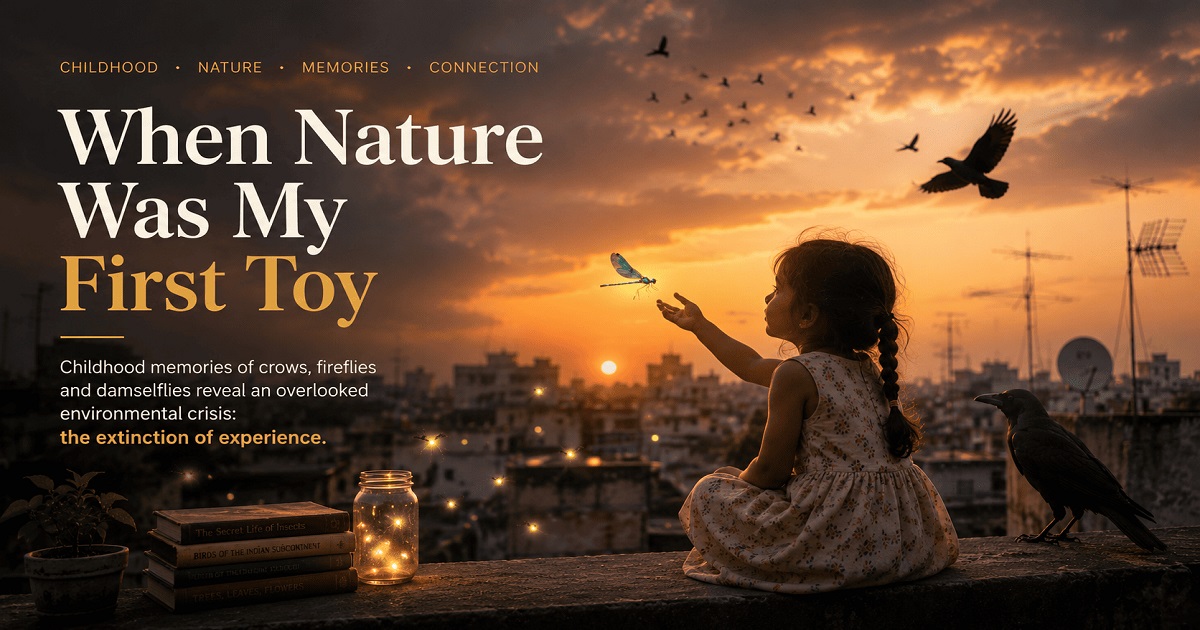
Where Have My Childhood Friends Gone?
Crows, Fireflies, Damselflies, and the disconnect with nature.
I. The Crow on the Rooftop
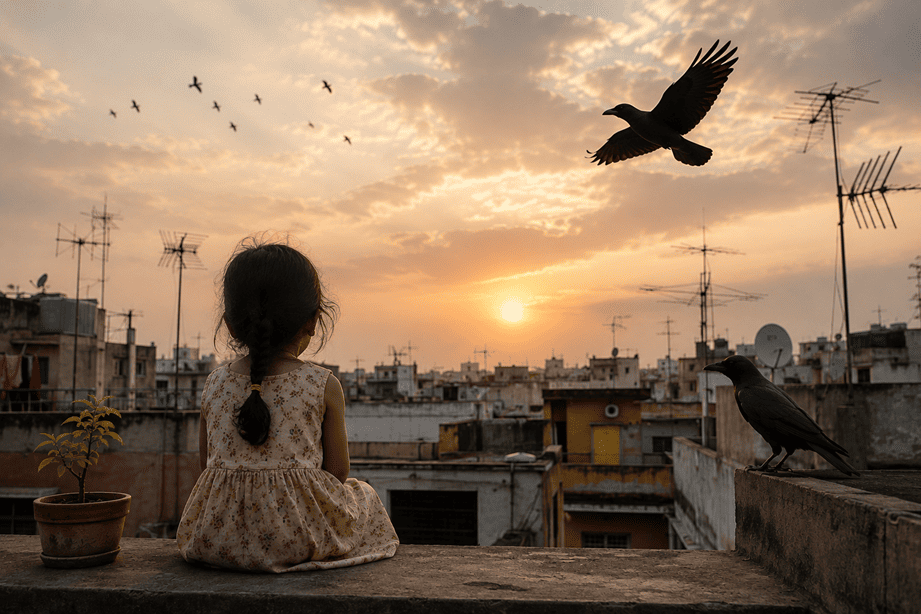
One of the sweetest memories of my childhood belongs to a time when I was barely two or three feet tall. On the railings of our house, a small feathered visitor would often sit—a crow that unknowingly became my first automatic toy. Every day, I would hear the familiar "caw-caw" echoing through the air, a sound that still rings within me like the alarm clock of my childhood. Being so small, I would hop excitedly toward the railing, waving my tiny hands and shouting, "Hush! Hush!" I never knew whether my words meant anything to the crow, but whenever it suddenly spread its wings and flew away, my heart filled with delight. It felt as though my claps were a magical remote control and the crow was a living toy responding to my command.
From the rooftop, I could see rows of old houses standing quietly under the sky. Many of them carried the familiar Yagi-Uda television antennas, those metal structures that once captured local television channels. The crows would often fly from the brick railing of our rooftop to those antennas, turning the neighborhood skyline into a stage for my daily entertainment. Watching them hop, perch, and take flight became a cherished ritual, a simple source of joy that required no batteries, no screens, and no instructions. Today, the antennas have disappeared, and so have many of those little moments. Yet in my memory, the crows still fly between those rooftops, carrying with them the innocence, wonder, and purity of a childhood that was deeply connected to the living world around it.
As I grew older (i'm 17 now), the world around me began to change, and so did my toys. The little winged companions that once filled my mornings gradually slipped out of my attention. In their place arrived the wonders of a new age—plastic, batteries, motors, and remote controls. Like many children of my generation, I became fascinated by the small remote-controlled cars that had become popular in the market. To me, they were magical. I still remember the excitement of receiving a small motorized car that I could sit in and drive around the house by pressing a pedal. It carried me across courtyards and open spaces with a sense of adventure that felt limitless. The old houses of those days had generous compounds and breathing spaces where such toys could roam freely, unlike the compact apartments and crowded high-rises that increasingly define urban childhood today.
Without realizing it, I had exchanged my first toy—the crow—for toys made of plastic and circuits. One belonged to nature and arrived every morning on its own; the others arrived in boxes, required batteries, and eventually stopped working. Yet childhood has a way of accepting every wonder with equal enthusiasm, and I immersed myself completely in these new forms of entertainment.
Years passed. School examinations came and went, and eventually I completed my twelfth grade. One quiet day, while sitting with my parents and discussing university admissions, I found myself in an unusual state of calmness. The noise of daily life seemed to soften. Thoughts about the future filled my mind, yet there was also a deep stillness. In that silence, an unexpected memory emerged from somewhere far within me—the memory of my very first toy.
Suddenly, I could hear the faint echoes of those familiar morning calls. I could see the brick railing of the rooftop, the old houses in the distance, and the crows perched patiently upon the Yagi-Uda antennas. It felt as if a forgotten chapter of my life had gently reopened. I realized that I had been searching for certainty about the future while unconsciously longing for something from the past.
"The crow was not a product. It was a presence."
Today, I look around and search for those same morning visitors, those same sounds that once arrived with such reliability that they became part of the rhythm of life itself. But they are harder to find. The antennas have vanished from rooftops, replaced by newer technologies hidden from sight. The open spaces have narrowed. The skyline has changed. And with these changes, many of my earliest companions seem to have disappeared as well.
The loss is not merely about crows or antennas. It is about the quiet extinction of everyday natural experiences. As technology advanced, it undoubtedly brought comfort, speed, and connection. Yet in gaining so much, we may have unknowingly lost countless small relationships with the living world around us. My childhood crow never needed to be charged, updated, repaired, or replaced. It appeared with the sunrise, sang its familiar song, and transformed an ordinary morning into an adventure. It was not a product; it was a presence.
Sometimes I wonder where that old friend has gone. Perhaps the crows still exist somewhere beyond my immediate view. Perhaps it is not they who have disappeared, but the environments and moments that once allowed our paths to cross so naturally. The Yagi-Uda antennas that served as their resting places have disappeared in the march of progress, and with them vanished a small stage upon which some of my most innocent memories were performed.
In remembering them, I am reminded that the extinction of natural experience does not always occur dramatically. Often it happens quietly, one missing sound, one removed rooftop antenna, one vanished morning visitor at a time. And only years later do we realize that what disappeared was not merely a part of the landscape, but a part of ourselves.
At the time, I did not realize that these small interactions with nature were shaping my childhood. Only years later would I understand that such ordinary encounters are becoming increasingly rare, and that their disappearance carries consequences far beyond nostalgia.
Yet the crow was not the only companion that shaped my childhood. If my mornings belonged to rooftops, birds, and the open sky, my evenings belonged to another kind of magic—one that flickered softly among the plants growing around our home.
THE CAWCAW NOTE
The smallest encounters with nature often become the strongest memories of childhood.
II. Nature's Lanterns
Another memory returns to me with the fragrance of wet soil and the colors of changing seasons. My parents and grandmother have always loved plants. No matter how busy life became, there was always a corner of the house reserved for nature. Every season brought its own ritual. Summer, monsoon, autumn, winter—each arrival was accompanied by an overhaul of the household plants. Old pots would be rearranged, new saplings would appear, dried leaves would be removed, and fresh blossoms would quietly announce the changing rhythm of the year.
As a child, I rarely understood the effort behind this tradition. To me, those plants were simply part of the house, as ordinary as walls and windows. Yet they gifted me something extraordinary.
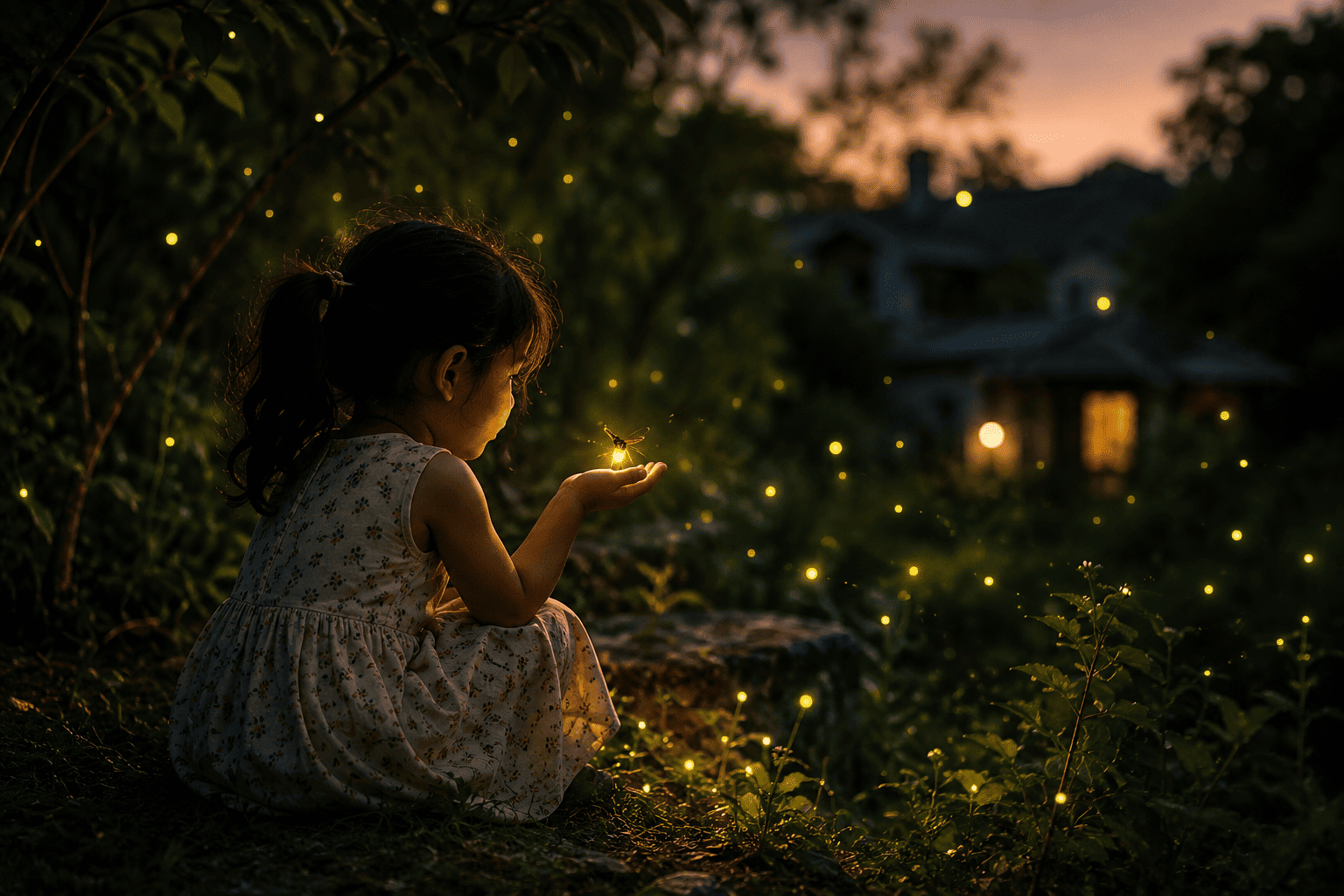
When evening descended and darkness slowly wrapped itself around the garden, tiny lights would begin to appear among the leaves. One by one, then dozens at a time, fireflies emerged from their invisible world. They were nature's own festival decorations. Their gentle flashes felt magical, as though the stars had become curious and descended from the sky to play among our plants.
I would stand and watch them with wide eyes. There was no switch to turn them on, no battery to replace, no wire connecting them together. They blinked according to a language known only to themselves. Sometimes they appeared suddenly, glowing for a brief moment before vanishing into darkness, only to reappear somewhere else. It was a game of hide-and-seek played with light itself.
But then, as I grew older, another kind of light entered my life.
Markets filled with colorful Chinese decorative lights. Neon strips, LED ropes, flashing bulbs, programmable patterns—lights that could dance, blink, sparkle, and change colors at the push of a button. Like every child captivated by novelty, I was enchanted. The quiet beauty of the firefly slowly faded from my attention. Why wait for a tiny insect to glow when entire walls could now shine in brilliant colors? Nature's lanterns were forgotten as I chased brighter, louder, and more dazzling lights.
Just as I had once exchanged the crow for remote-controlled toys, I unknowingly exchanged fireflies for LEDs.
The transition happened so naturally that I never noticed it.
Years later, as memories began returning one by one, I found myself searching for those tiny evening stars again. I looked among the plants. I looked near the garden. I looked during the same hours when they used to appear. Somewhere inside me was the certainty that they would return if only I waited long enough.
But they did not come.
The decorative lights still exist. In fact, there are more of them than ever before. Buildings sparkle brighter, shops glow longer, and cities remain illuminated throughout the night. Yet the fireflies seem to have quietly withdrawn from the scene.
And so I find myself waiting.
Waiting like an old friend standing at a railway station long after the train has departed. Waiting for a familiar flash among the leaves. Waiting for a tiny green light to emerge from the darkness and tell me that it has merely been late all these years.
But the garden remains still.
Perhaps this is what the extinction of natural experience feels like. Not a dramatic disappearance that captures headlines, but a silent absence that only becomes noticeable when we try to revisit an old memory. The LEDs became brighter while the fireflies became fewer. The artificial lights grew more efficient while the natural lights grew more distant. Progress illuminated our surroundings, yet in some places it dimmed our relationship with the living world.
What saddens me most is that many children today may never know what it feels like to chase a firefly through a summer evening. They may know thousands of lighting patterns designed by engineers, but never witness the humble miracle of a creature carrying its own lantern. They may see brighter lights than I ever did, yet miss one of the gentlest wonders that nature once offered freely.
And sometimes, when evening arrives and the first lights of the city begin to glow, I find myself looking into the darkness one more time, hoping to see a tiny flicker among the leaves. Not because it is brighter than the neon lights that replaced it, but because it belongs to a world that made childhood feel alive, mysterious, and beautifully connected to nature.
If the rooftops introduced me to birds and the evenings introduced me to fireflies, school introduced me to yet another childhood companion—one that danced above the grass and welcomed me into a new world.
III. The Little "Teela"
After the memories of rooftops, crows, gardens, and fireflies, another forgotten friend returns from the earliest pages of my childhood.
I was barely two or three feet tall when I was admitted to a new school after completing preschool. Like countless children stepping into an unfamiliar world, my first day was not a particularly happy one. Everything felt new—the classrooms, the uniforms, the teachers, the faces. I still remember standing there as my father dropped me off. He smiled, waved goodbye, and walked away. A few moments later, I turned around to look for him again, but he was already gone. For a small child, that brief moment felt enormous. The familiar world have become increasingly difficult to encounter., and I was left standing in a place that seemed far too large.
The first period somehow passed. Then we were taken to the school ground. There, among dozens of unfamiliar children, stood a little girl who would become my first friend in that school, though I did not even know her name yet.
And then, something wonderful happened.
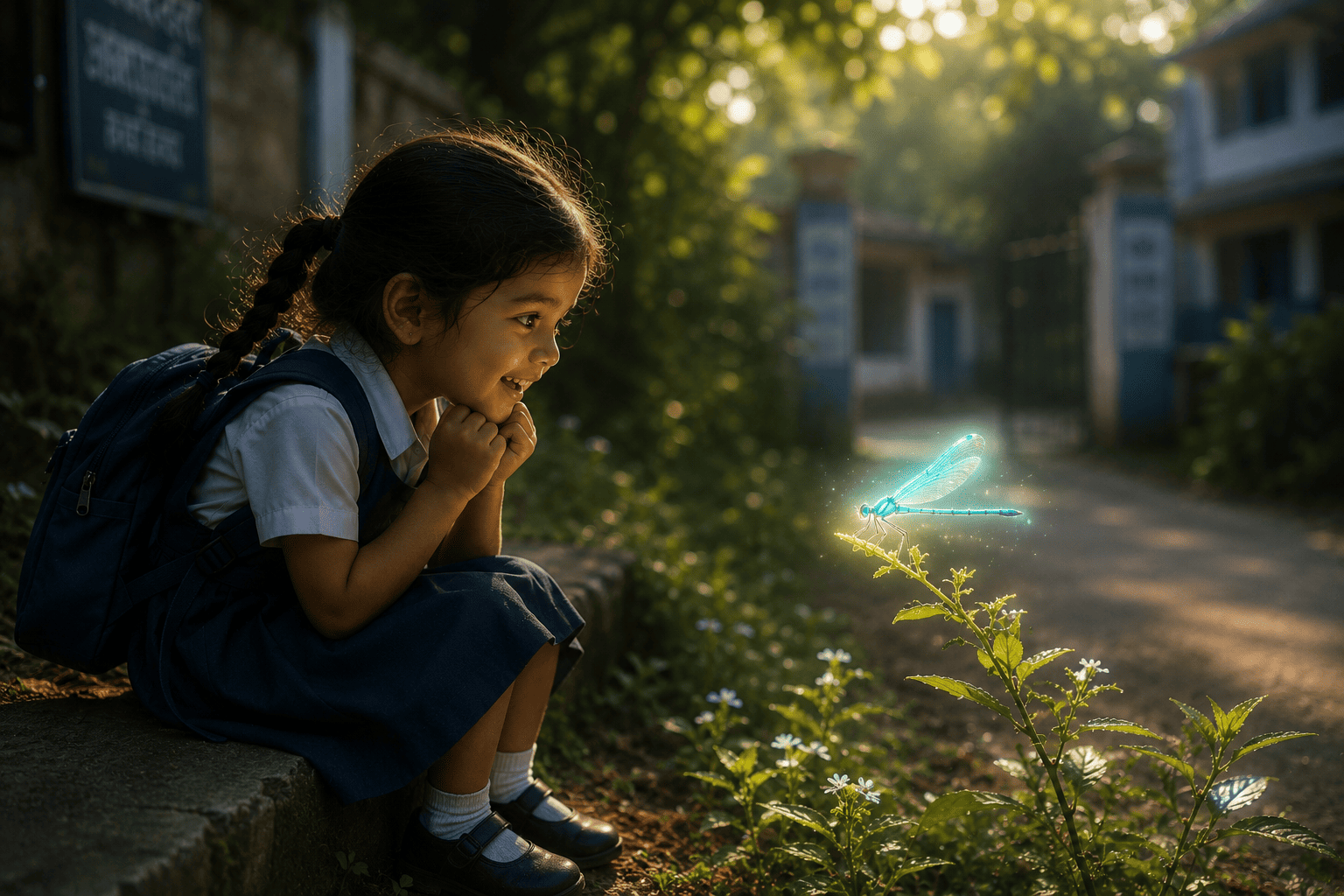
"A child sees a friend where an adult sees an insect."
Our attention was suddenly captured by a tiny creature dancing among the grass.
"Teela! Teela!" the children shouted excitedly.
That was what everyone called it—a "teela."
The word literally meant a twig, and perhaps it earned that name because of its delicate, slender body. It flew lightly from one blade of grass to another, as though the wind itself had learned how to take shape. Its body shimmered with shades of green and blue, glowing like a tiny jewel under the sunlight. To my young eyes, it was one of the most beautiful things I had ever seen.
At that moment, I completely forgot that it was my first day at school.
I forgot the nervousness.
I forgot that my father has returned, and im on my own here.
I forgot the unfamiliar classrooms.
The adventure had begun.
For what felt like hours, we watched those tiny flying wonders darting through the grass. They never sat still for long. They floated, hovered, landed, and vanished before suddenly appearing again somewhere else. It was as if they were inviting us into a secret game that only children could understand.
Today, I know that those little "teelas" were damselflies.
But back then, they were not insects.
They were friends.
They were entertainers.
They were the welcoming committee of my first school day.
Yet, just as it happened with the crows and the fireflies, time quietly changed my attention.
School introduced me to new fascinations. Bright colour pencils, sketchbooks, crayons, charts, projects, and books gradually occupied the space once held by the little damselflies. I became busy drawing colours onto paper while forgetting the living colours that fluttered across the playground. The teelas disappeared from my thoughts, replaced by the routines and ambitions of growing up.
Years passed.
Assignments replaced playtime.
Examinations replaced exploration.
Screens replaced open fields.
And somewhere along the way, those tiny blue-green companions slipped out of memory.
Until one day, they returned.
Not physically, but through remembrance.
After finishing school and looking back on childhood, I found myself thinking about that first day again. The image appeared with surprising clarity—the grass, the sunlight, the excitement, and the tiny creature flying from blade to blade.
Recently, I visited a park.
Perhaps I was not consciously searching for them, but part of me hoped they would be there. I walked near patches of grass and looked carefully among the plants. Somewhere inside me lived the expectation that a slender blue-green flash would suddenly rise into the air and transport me back to that school playground.
But none appeared.
I searched again.
Nothing.
The grass was there.
The pathways were there.
The benches were there.
But the teelas were missing.
And I found myself asking the same question I had asked for the crows and the fireflies:
Where are those old friends now?
Where are the tiny companions that once turned an ordinary school ground into a magical kingdom?
Where are the creatures that comforted a frightened child on his very first day of school?
Today, I encounter them far less frequently than I once did. Perhaps they still survive somewhere beyond the places I now visit. Yet their absence feels meaningful. The parks seem cleaner, more organized, and more modern than before, but somehow less alive. The colours in my pencil box became brighter, yet the living colours that once danced among the grass seem harder to find.
And once again, I am reminded that the extinction of natural experience is not only the disappearance of species. It is also the disappearance of relationships. A child does not see a damselfly as a biological indicator of ecosystem health. A child sees a friend, a playmate, a source of wonder.
When those encounters vanish, something else vanishes with them—a small doorway through which curiosity, affection, and connection with nature quietly enter the human heart.
Perhaps that is why I still remember the teela after all these years.
Because on a day when I felt alone in a new school, a tiny blue-green creature landed among the grass and taught me that the world was still full of friends waiting to be discovered.
IV. The Lost Connection
And then a question begins to trouble me.
If today's children never hear the morning calls of crows from their rooftops, how will they miss them when they are gone?
If they never chase fireflies through summer evenings, how will they understand what has disappeared from the night?
If they never kneel in the grass to watch a tiny "teela" dance between blades of green, how will they learn to care about damselflies, wetlands, ponds, and the countless invisible threads that hold nature together?
How can anyone protect what they have never known?
How can anyone love what they have never met?
This is perhaps the most concerning consequence of our times.
The extinction crisis is not only happening among species. It is also happening within human experience.
This suddenly gives meaning to my own memories.
Why did the crow return to my thoughts?
Why did I remember the fireflies?
Why did I find myself searching for damselflies years after forgetting them?
Perhaps the answer lies in my childhood itself.
My father has always been a responsible wildlife enthusiast. From my earliest years, he never treated nature as something distant or reserved for forests and documentaries. He pointed out birds sitting on rooftops. He showed me insects resting on leaves. He helped me notice creatures that most people walked past without seeing. Long before I learned scientific names, I learned familiarity. Long before I learned conservation, I learned affection.Long before I learned names, categories, I learned wonder.
The connection came first.
Knowledge came later.
That connection became a thread running quietly through my childhood. Even when I forgot those creatures for years, the thread never completely broke. It simply waited. And when life became quieter, when I paused long enough to reflect, those memories returned and gently pulled me back toward nature.
But what happens when that thread is never woven at all?
What happens when a child grows up surrounded only by concrete, screens, notifications, traffic, and artificial entertainment?
What happens when childhood memories contain hundreds of digital characters but not a single living firefly?
The answer should concern all of us.
Because a child who has never watched a butterfly emerge from a flower patch may never notice when butterflies decline.
A child who has never listened to frogs after rainfall may never wonder why the ponds have fallen silent.
A child who has never known a damselfly may never realize that wetlands are disappearing.
The danger is not indifference.
The danger is invisibility.
Things disappear most easily when nobody notices they were there.
Research increasingly suggests that direct experiences with nature are among the strongest influences on future conservation attitudes and environmental responsibility. Children protect what they feel connected to. They defend what they understand. They value what has become part of their personal story.
This means that conservation does not begin with laws.
It begins with encounters.
It begins when a grandparent points to a bird.
It begins when a parent pauses during a walk to admire a flower.
It begins when a teacher allows students to observe insects in a school garden instead of only reading about them in textbooks.
It begins when children are given opportunities to experience wonder.
Schools therefore have a responsibility that extends far beyond examinations and grades. Every educational institution should create opportunities for children to meet nature directly. Not merely through diagrams and photographs, but through gardens, biodiversity corners, tree walks, bird observations, butterfly patches, seasonal planting activities, and outdoor learning experiences.
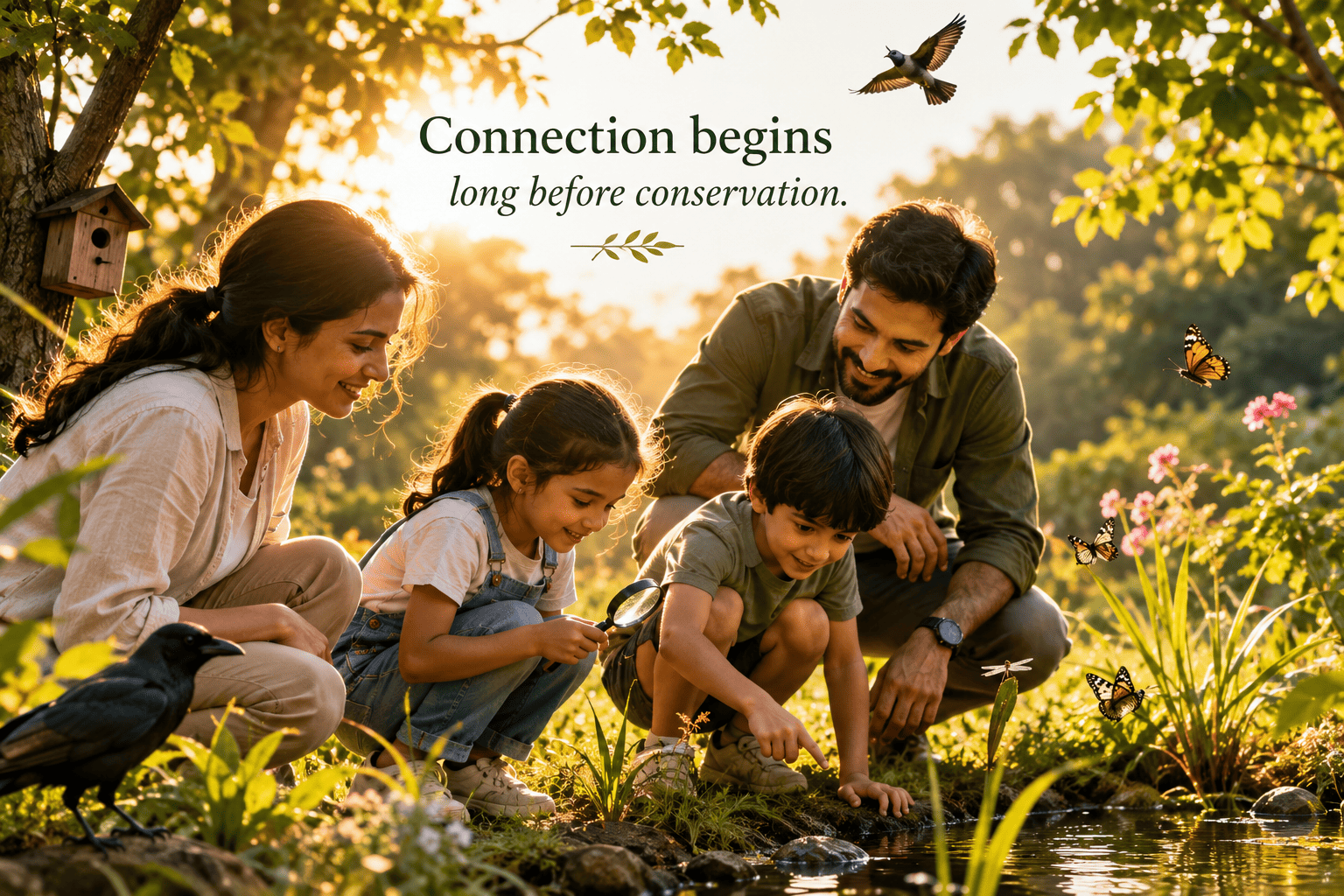
Families have an equally important role.
A child does not need expensive vacations or exotic wildlife expeditions to connect with nature.
A crow on a railing is enough.
A firefly in a garden is enough.
A damselfly in a patch of grass is enough.
A flowering plant on a balcony is enough.
Connection begins with attention.
And attention begins when an adult says, "Look."
EXTINCTION OF EXPERIENCE
The progressive, ongoing alienation of children from direct, everyday interactions with nature.
(Robert M Pyle, Masashi Soga and Kevin J. Gaston)V. Why Connection Matters
Today, as humanity discusses biodiversity loss, climate change, and environmental degradation, we must also discuss another extinction that receives far less attention—the extinction of childhood encounters with the living world.
Because when experiences disappear, memories disappear.
When memories disappear, affection disappears.
When affection disappears, responsibility disappears.
And when responsibility disappears, conservation becomes a battle fought only through policies instead of through love.
The crow on the rooftop, the firefly among the plants, and the little teela in the school grass may seem insignificant in the grand story of global biodiversity. Yet to a child, they are ambassadors of nature. They are introductions. They are first friendships.
If we wish future generations to protect nature, we must first allow them to meet it.
Not through screens.
Not only through books.
But through living experiences.
For in the end, people do not protect what they are told to protect.
They protect what they have learned to love.
And before children can learn to love nature, they must first be given the chance to meet it.
THE LAST CAW
People do not protect what they are told to protect.
They protect what they have learned to love.
And before children can learn to love nature,
they must first be given the chance to meet it.

Jigyasa Sood
Jigyasa Sood explores the small connections between people and nature, observations on society, nature and everyday moments that reveal larger stories. Her perspectives focus on curiosity, responsibility and noticing what often remains unnoticed.
CONTINUE THE JOURNEY
CAWCAW welcomes thoughtful feedback, comments, and perspectives. Write to us at [email protected].